
Curated Portfolio Archive & Developer Community
DEV/STATION
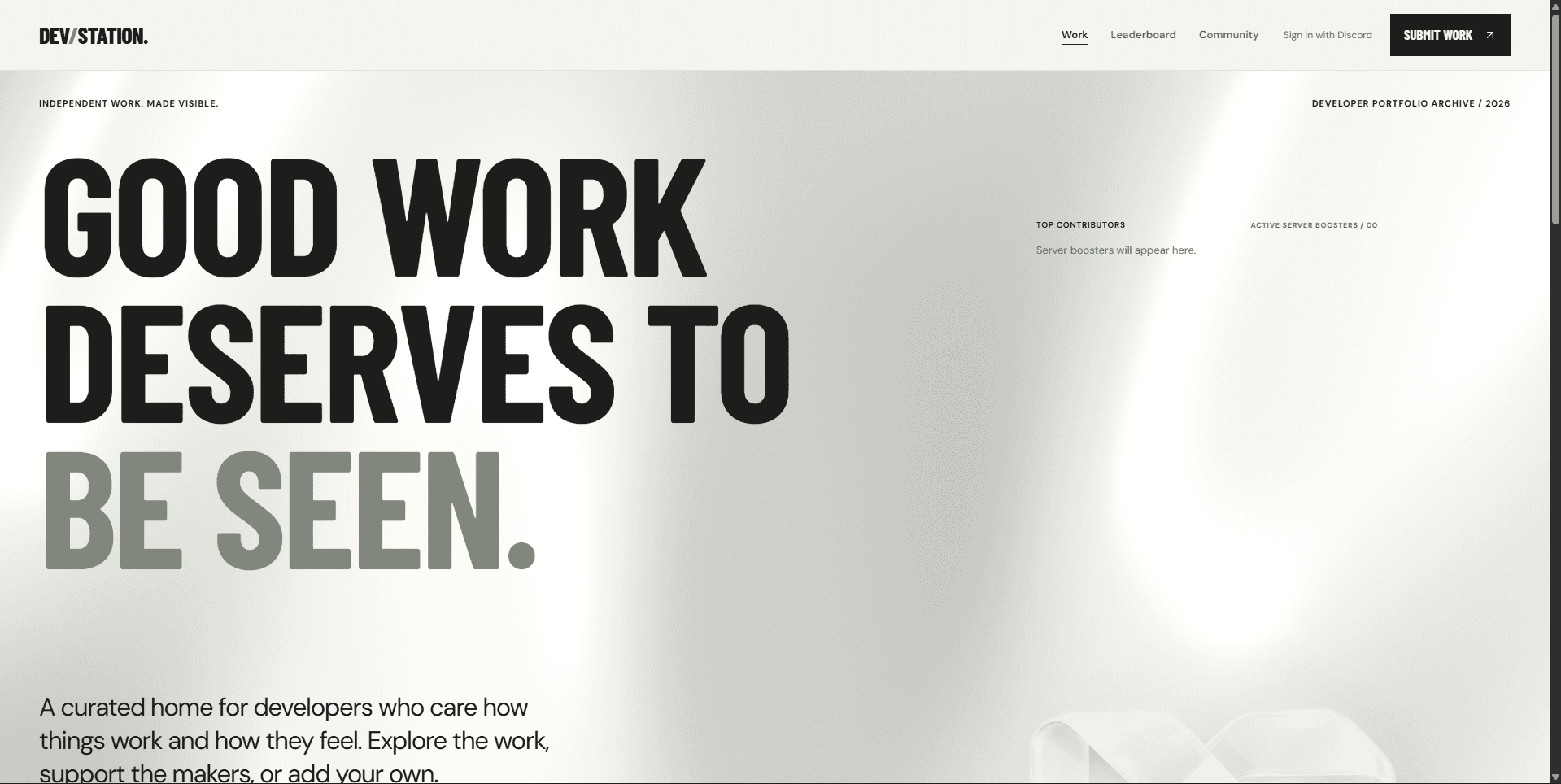
DEV/STATION is a curated developer portfolio archive and community independently created, designed, and built by Jhet Tacalig, with four-pillar peer ratings and a 3D gallery.
Case study
I independently created, designed, and built DEV/STATION as a curated digital archive and community for independent developers. Its ecosystem includes the discovery platform, a dedicated Android application, and DEVVY UI, the open-source React design system I engineered.
[01] EXECUTIVE SUMMARY
DEV/STATION gives independent developers a place to discover creative websites and full-stack applications without algorithmic feed clutter. Portfolios receive constructive ratings across Design, Interaction, Performance, and Creativity. A global leaderboard, Editor’s Choices, live multi-viewport previews, saved work, and a 3D gallery support peer-driven discovery. I built the interface, application logic, and infrastructure with Next.js, Supabase, Cloudflare R2, and Vercel.
[02] CASE STUDY 1 — DESIGNING A BETTER WAY TO EXPLORE PORTFOLIOS
MAKING THE WORK EASIER TO JUDGE
A portfolio screenshot can show visual style, but it cannot show how a site behaves. I built DEV/STATION around the idea that visitors should be able to inspect the work itself before rating it.
The interface takes cues from an editorial archive: large typography, a restrained palette, thin rules, and clear hierarchy. Each portfolio opens in a live viewer with desktop, tablet, and mobile widths, plus screenshots when a live embed is unavailable. Visitors can examine the project, read its context, and save it for later.
I also separated saving from rating. The heart is a personal bookmark; ratings use four criteria—design, interaction, performance, and originality. This gives members a more useful way to respond to creative development work than a single like count.
The result is a browsing experience built around the portfolio, with the site’s controls kept deliberately quiet.
[03] CASE STUDY 2 — BUILDING FAIR VOTING AND COMMUNITY RECOGNITION
CONNECTING THE ARCHIVE TO ITS COMMUNITY
DEV/STATION needed more than a gallery. Members had to sign in, submit work, rate portfolios fairly, and carry their identity between the website and Discord.
I used Discord sign-in through Supabase Auth and stored portfolios, ratings, and saved work in Supabase Postgres. Database rules enforce one rating per person per portfolio and a limit of ten ratings every 48 hours, so those rules still apply if someone bypasses the website interface. Portfolio images upload to Cloudflare R2 through short-lived signed URLs.
Recognition has distinct paths. Community picks come from current ratings, while reviewers publish three dated editor selections each week. Earlier selections remain in a Hall of Fame and cannot be picked again. Verified Discord server boosts can also give a portfolio premium recognition. Submission review and copyright reporting give admins tools to manage the archive as it grows.
This turned DEV/STATION into a connected portfolio and community system, rather than a collection of project cards.
[04] CORE DELIVERABLES & TECHNICAL SPECIFICATIONS
- Editorial Archive & Multi-Viewport Live Viewer: Clean architectural UI with live responsive preview frames (Desktop, Tablet, Mobile) and fallback high-resolution screenshot rendering.
- 4-Dimension Structured Rating Engine: Granular evaluation across Design, Interaction, Performance, and Originality, separating personal bookmarks from community scores.
- Database-Enforced Anti-Abuse Rules: Supabase PostgreSQL RLS ensuring strict one-rating per portfolio and a maximum rate of 10 ratings per 48 hours per member.
- Cloudflare R2 Signed Ingest Pipeline: Direct client-to-storage short-lived presigned URL uploads with zero server memory overhead.
- Discord OAuth & Community Ecosystem: Seamless Discord authentication, server boost verification for premium recognition, and Hall of Fame curation lifecycle.
[05] TECH STACK
- Frontend Architecture: Next.js 16 (App Router), React 19, TypeScript 5, Tailwind CSS v4
- Authentication & Database: Supabase Auth (Discord OAuth), Supabase PostgreSQL with RLS & Rate-Limiting Constraints
- Storage & Edge Infrastructure: Cloudflare R2 (Presigned S3 API), Vercel Edge Network
Explore DEVVY UI, the React design system I built for the DEV/STATION ecosystem.